
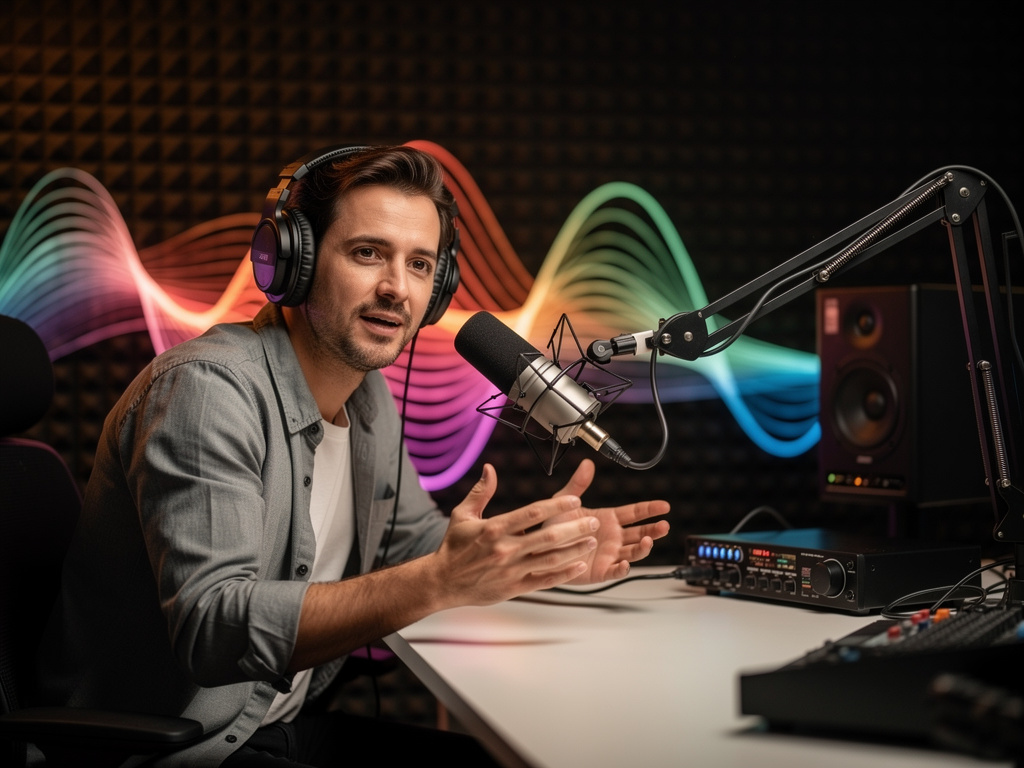
Most articles about voice AI tools are just thinly-veiled product catalogs that don't address what content creators and podcasters actually need. Let's change that.
As both a content creator and podcast producer, you're not looking for a list of features or buzzwords. You need tools that solve real problems: turning around episodes faster, maintaining consistent audio quality, and scaling your content production without sacrificing your unique voice and style.
The truth is, while voice AI technology has advanced significantly, not every tool delivers on its promises. Some highly-marketed solutions actually create more work than they save. Others are genuinely transforming how creators work, but their real value isn't where most people think.
Let's cut through the hype and examine which voice AI tools are truly making a difference for content creators and podcasters today, based on real-world results and expert analysis from Narration Box.
Voice-to-Text Transcription and Editing Tools
The foundation of efficient content creation starts with accurate transcription and smart editing capabilities. The best tools in this category don't just convert speech to text – they understand context, maintain speaker attribution, and help you edit your audio by editing text.
Modern AI-powered transcription tools have evolved beyond basic speech recognition. They can now detect different speakers, capture emotional nuances, and even suggest edits based on pacing and content flow. This means you can edit your podcast or video content as easily as editing a document, with the audio automatically adjusting to match your text changes.
The real game-changer here is how these tools handle the back-and-forth between text and audio. Instead of working in silos (transcript in one window, audio editor in another), the best solutions create a seamless workflow where edits in either format instantly update the other.
For multilingual content creators, these tools are particularly valuable. They can provide real-time translations while preserving the emotional intent and pacing of the original audio, making it possible to reach international audiences without recording multiple versions.
This is where tools like Hydra by Smallest AI shine, offering real-time processing where speech and text work together simultaneously, preserving emotional conditioning that's often lost in traditional transcription.
AI Voice Cloning for Consistent Audio Production
Voice cloning technology has matured beyond simple mimicry. The best tools now capture the subtle nuances of voice – personality quirks, emotional range, and even micro-expressions that make speech sound natural.
For content creators, this means being able to maintain consistent voice quality across all your content, even when recording in different environments or when you're not feeling your best. It also enables you to create content in advance and update it later without needing to match your original recording conditions.
Podcasters are finding particular value in using voice cloning for ad reads and sponsorship messages. Instead of breaking the flow of your show with obviously different-sounding ad insertions, you can generate them in your own voice, maintaining the authentic connection with your audience.
The key is choosing tools that prioritize voice fidelity and emotional preservation over speed. The best solutions analyze hours of your voice data to create a deep learning model that captures not just how you sound, but how you express yourself.
Common Voice AI Misconceptions
Myth
AI voice tools sound robotic and can't capture human emotion
Reality
Modern voice AI preserves emotional nuances and natural speech patterns through advanced neural networks and emotional conditioning
Interactive Content Creation Tools
The future of content isn't just about passive listening – it's about creating interactive experiences. Leading voice AI tools now enable creators to build content that responds to audience engagement in real-time.
Think beyond traditional podcasts or videos. These tools allow you to create branching narratives where viewers or listeners can choose their own path through your content. For educational content creators, this means developing adaptive learning experiences that adjust to each student's pace and understanding.
The most effective tools in this category combine voice synthesis with natural language processing, allowing for dynamic content generation based on user input or behavior. This opens up possibilities for personalized content experiences at scale – something that would be impossible to achieve with traditional recording methods.
For podcasters, this technology enables live audience interaction during recorded shows, AI-powered Q&A sessions, and even personalized episode variations based on listener preferences or history.
Audio Quality Enhancement and Restoration Tools
Nothing frustrates creators more than discovering audio quality issues after recording. Modern voice AI tools are changing the game in audio post-processing, offering capabilities that were once only available in professional studios.
These tools can now intelligently separate voices from background noise, fix room acoustics, and even reconstruct lost audio data. The best solutions use deep learning models trained on vast databases of high-quality audio to understand what 'good' sound should be.
More impressively, they can maintain consistency across different recording environments. If you need to record parts of your content in different locations or with different equipment, these tools can match the audio characteristics to maintain a cohesive sound throughout.
For creators who work with guest interviews or remote recordings, these tools are particularly valuable. They can harmonize audio from different sources, correct for poor microphone quality, and even improve the clarity of compressed audio from video calls.
Traditional vs. AI-Enhanced Content Creation
| Aspect | Traditional Process | AI-Enhanced Workflow |
|---|---|---|
| Production Time | Manual editing and processing | Automated real-time processing |
| Scalability | Limited by recording time | Unlimited content variations |
| Quality Control | Varies with conditions | Consistent across sessions |
Content Repurposing and Distribution Tools
Creating content for multiple platforms doesn't have to mean starting from scratch each time. The latest voice AI tools excel at helping you repurpose your content efficiently.
The best tools in this category can automatically generate variations of your content optimized for different platforms. For example, turning a long-form podcast into bite-sized social media clips, complete with automatically generated captions and audio optimized for mobile devices.
They can also help you localize content for different markets by generating translations that preserve your original tone and delivery style. This isn't just about changing the words – it's about maintaining the emotional impact and cultural relevance across languages.
Smart distribution features help you optimize release timing and format for different platforms, ensuring your content performs well wherever it's published. This includes automatic adjustments for platform-specific requirements like duration limits or audio format specifications.
Real-Time Voice Processing for Live Content
Live content creation presents unique challenges that static tools can't address. The newest generation of voice AI tools offers real-time processing capabilities that transform live streaming and broadcasting.
These tools provide instant audio enhancement, real-time translation, and voice modulation without perceptible delay. This means you can deliver professional-quality live content without extensive pre-production or post-processing.
For live podcasters and streamers, these tools offer features like automatic profanity filtering, voice effects that can be adjusted on the fly, and real-time audience interaction through voice commands. The best solutions maintain sub-300ms latency, ensuring natural conversation flow even in interactive scenarios.
Perhaps most importantly, these tools can help maintain consistent energy levels throughout long sessions, automatically adjusting your voice to sound energetic and engaged even during extended broadcasts.
Conclusion
The landscape of voice AI tools is evolving rapidly, but success lies in choosing solutions that truly align with your content creation workflow. The best tools don't just offer impressive technology – they solve real problems that content creators and podcasters face daily.
As these technologies continue to mature, we're seeing a shift from basic voice synthesis to comprehensive content creation platforms that understand context, preserve emotion, and enable truly scalable production. The key is finding tools that enhance your creative process rather than replacing it, allowing you to focus on what matters most: creating engaging content that connects with your audience.

How Hydra by Smallest AI Enhances Content Creation Workflow
Smallest AI
Multi-modal Processing
Edit your content in either speech or text form, with both updating in real-time
Emotion Preservation
Maintains the emotional nuances of your voice even through edits and processing
Sub-300ms Latency
Enables truly natural conversation flow for live content creation
Frequently Asked Questions
Sources & References
- 1
6 Best AI Voice Generators for Content Creators in 2025
https://www.beatoven.ai/blog/ai-voice-generators/
- 2
Top AI Voiceover Tools in 2024: The Best AI Solutions for Content ...
https://www.linkedin.com/pulse/top-ai-voiceover-tools-2024-best-solutions-contentcreators-ifvnf
- 3
11 Best AI Voice Cloning Tools for Creator Dubs - OpusClip Blog
https://www.opus.pro/blog/best-ai-voice-cloning-tools-for-creator-dubs
- 4
Best AI Voice Generators for Podcast Creation: A Guide to Sy
https://narrationbox.com/blog/best-ai-voice-generators-for-podcast-creation-a-guide-to-synthetic-audio
- 5
Top AI Tools for Content Creation in 2024 - Ali Onar
https://alitunacanonar.medium.com/best-ai-tools-to-automate-content-creation-in-2024-97f3b06c3776
- 6
The 9 best AI voice generators in 2025
https://zapier.com/blog/best-ai-voice-generator/
- 7
The Best AI Voice Cloning Tools in 2024
https://www.opus.pro/blog/the-best-ai-voice-cloning-tools-in-2024
- 8
Best AI Voice Generator Software in 2024
https://www.powtoon.com/blog/ai-voice-generator-software/
- 9
Level up your podcast - Best AI tools in 2024 | Bridge.audio
https://www.bridge.audio/blog/level-up-your-podcast-best-ai-tools-in-2024/
- 10
The 7 best AI voice generators for 2026 - WellSaid Labs
https://www.wellsaid.io/resources/blog/best-ai-voice-generator
- 11
Best AI Podcasting Tools in 2024
https://hurrdatmedia.com/podcasting/best-ai-tools-to-use-for-your-podcast/
- 12
Best AI Voice Generators To Create Videos in 2024 - Instapage
https://instapage.com/blog/best-ai-voice-generators/
More from Smallest AI
How to Automate Your Podcast Transcription: A Step-by-Step Guide for Content Creators
Learn how to automate podcast transcription effectively. Transform your audio content into searchable text, improve accessibility, and streamline content repurposing.
Voice Fatigue Solutions: How AI Speech Generation Saves Creator Health
Discover how AI speech generation helps YouTubers and course creators protect their vocal health while scaling content production. Learn sustainable voice solutions for content creators.
How to Transform Your Podcast Audio into SEO-Rich Content Automatically
Learn how to automate podcast transcription and convert your audio content into SEO-optimized text, show notes, and social media posts efficiently.